
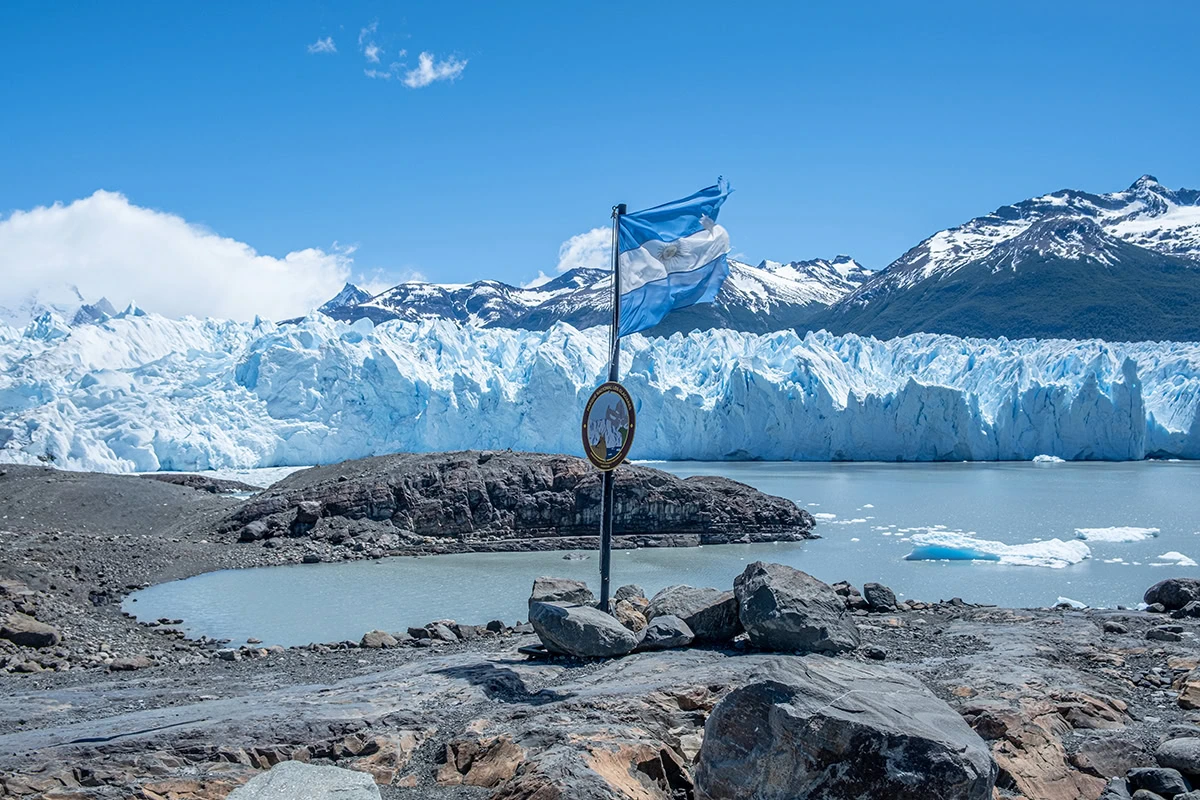
Seeing a glacier was at the top of my Patagonia bucket list. I couldn’t leave without standing in front of one.
My first chance was Glacier Grey in Torres del Paine. Rain, wind, and a cancelled boat put an end to that.
So Perito Moreno was it. My last shot. And I didn’t just want to see it from a distance — I wanted to get as close to that wall of blue ice as humanly possible.
The obvious answer was the mini-trek, where you strap on crampons and walk on the glacier itself. I would have loved to do it. But the tour agency has strict rules: you have to be under 65 for the mini-trek, under 50 for the longer Big Ice trek, under a BMI of 30, and free of pacemakers and other health issues. Plenty of people get ruled out before they even start. And for those who qualify, the price tag (well over $300 USD) rules out plenty more.
So was I stuck with a boat ride and a distant view from the walkways?
Turns out, no. There’s a tour that gets you so close to the glacier you can literally reach out and touch it — no crampons, no BMI chart, no pacemaker clearance required. Just a 1.5-kilometer (1-mile) hike along the shore to the base of the ice.
That, I could do.
And it was all for around $150.
That, I could afford.
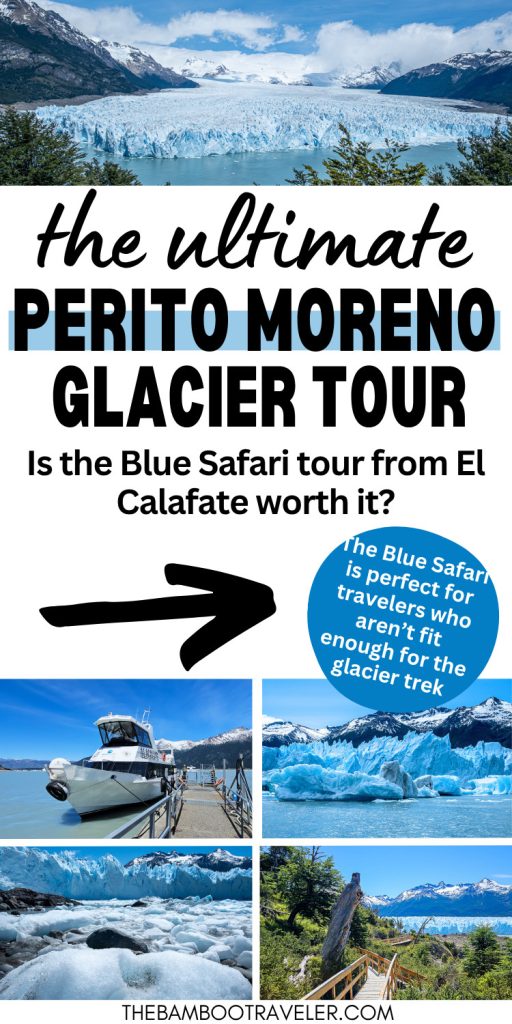
It’s called the Safari Azul (Blue Safari), and it gave me three completely different views of Perito Moreno in a single day: from above on the walkways, from the water on a boat, and from the ground at the glacier’s feet. Most tours give you one. And here’s the kicker — it costs roughly the same as tours that only include the boat and the walkways.
This post walks you through everything: what the Blue Safari includes, how to book it, what the park ticket costs, and exactly what to expect from pickup to drop-off.
Disclosure: This post may contain affiliate links. As an Amazon Associate and a Bookshop.org Associate, I earn from qualifying purchases. Please see this website’s Disclosure for more info.
What Is the Safari Azul Tour?
The Safari Azul (Blue Safari) is run by Hielo y Aventura, the main tour operator in El Calafate — and the only one with permission to land tour groups on the glacier side of Lago Rico. The tour combines three experiences into one full day.
- First, there’s the walkways and observation deck — the classic viewpoint above the glacier.
- Next comes a boat ride across Lago Rico and along the face of the glacier.
- And finally, the part most visitors never get to experience: an easy hike to the base of the glacier where you can actually touch the ice.
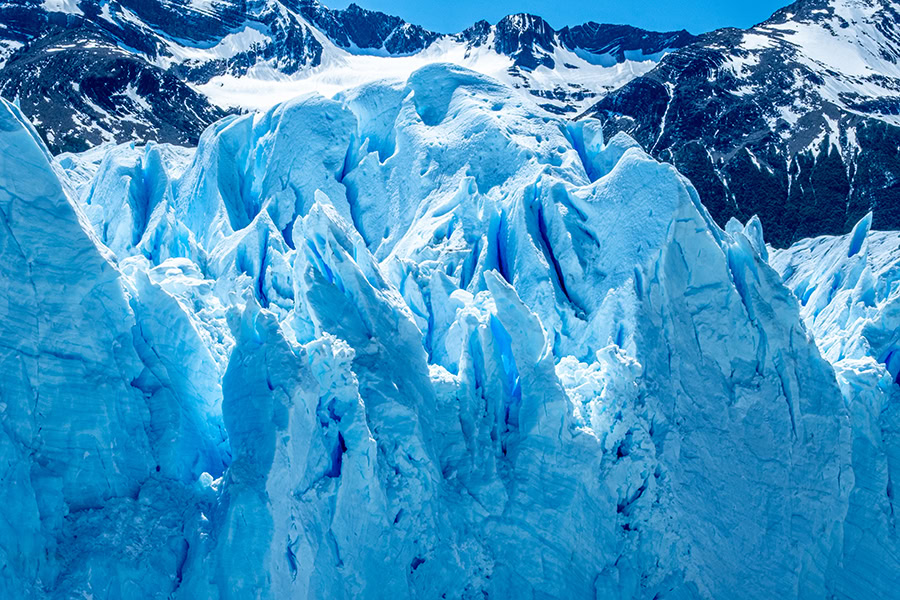
That third part is what separates this tour from everything else. It’s the difference between looking at the glacier from across a channel and standing at its feet, looking up at a 20-story wall of ice.
The Price Is the Real Surprise
Here’s what I didn’t expect: the Blue Safari costs about the same as a standard tour that only includes the walkways and a boat ride.
Currently, the Blue Safari is $99 USD without hotel pickup and $151 with hotel pickup. Compare that with the other options. Most standard walkways + boat tours from El Calafate run between $90 and $180 USD, depending on the operator and whether pickup is included. And the mini-trek? Well over $300 USD, and that’s before the park ticket. So for roughly the same price as a standard tour, you get a third experience that the other tours can’t offer — the hike to the base of the glacier.
Argentina has high inflation, and prices increase month by month, so double-check current rates when you book.
If you don’t choose hotel pickup, you’ll need to get yourself to the port or walkways by rental car, taxi, or bus.
When to Book
The tour is popular, so book ahead in high season — but make sure your booking is refundable. In the low season, you can often book just a few days out. That’s actually a strategy: it lets you pick a day with the best weather — less windy, clearer skies. Check Windguru to see what’s coming.
Los Glaciares National Park Ticket
Perito Moreno sits inside Los Glaciares National Park. The park ticket is not included in your tour price. You have to buy it separately.
Before we get into the logistics, a little context on what you’re paying to enter. Los Glaciares is a UNESCO World Heritage Site. It earned that status for two reasons: its exceptional natural beauty and its value as a living laboratory for the study of glaciation. Scientists can study the same geological forces that shaped the planet during the Ice Age by watching this glacier advance and retreat in real time. It’s one of the few places on Earth where that process is still happening and still accessible.
The park has 47 glaciers, all fed by the Southern Patagonian Ice Field, the third largest reserve of fresh water in the world after Antarctica and Greenland. Perito Moreno covers 250 square kilometers. That’s more than twice the size of San Francisco. It’s big. And it’s still not the biggest glacier in the park. That’s Upsala, at 870 square kilometers. But Upsala has been retreating since 2001, and icebergs now block boats from getting close enough to see its face. Perito Moreno gets all the attention because you can actually get to it.
The park covers three zones:
- Northern Zone: The famous Fitz Roy, world-class hiking trails, and the base town of El Chalten
- Central Zone: No lakes, no tourist infrastructure, essentially wilderness. Estancia Helsingfors is the one reason to go there.
- Southern Zone: Perito Moreno, Upsala, Spegazzini glaciers, Lake Argentino, base town of El Calafate. This is the zone you’re visiting for the Blue Safari tour.
Ticket options (as of April 2026):
- Day Pass — $45,000 ARS (approx. $32 USD)
- 3-Day Pass — $90,000 ARS
- 7-Day Pass — $157,500 ARS
All tickets are good for all zones.
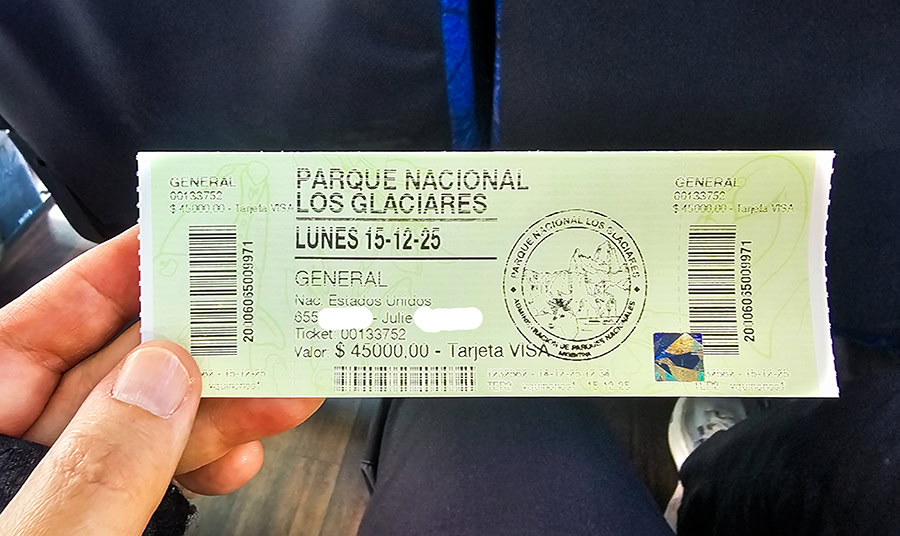
Good to know: if you buy the Day Pass, you get a 50% discount on any other park visit within 72 hours. So if you visit Perito Moreno on Monday, you can visit the El Chalten area on Wednesday for $22,500. The website says 72 hours, but I used mine 96 hours later. It still worked.
You can buy online or at the entrance. They accept cash and credit/debit cards. I bought mine online for $45,000 and downloaded the ticket to my phone. Easy.
Pro tip: Visit the Glaciarium before your Perito Moreno day. It’s a museum just outside El Calafate dedicated entirely to glaciers. You’ll learn about how glaciers form, move, and calve, and all of that context makes standing in front of Perito Moreno so much richer. Just skip the Ice Bar in the basement. Cheesy. Overpriced.
And since we’re here: what actually IS a glacier? A glacier is just layers upon layers of snow and ice, compressed over centuries into a slow-moving river of frozen water.
My Tour Experience
Pickup
Pickup was scheduled for 9:00 AM, so no brutal early alarm, which I appreciated. When I bought the tour, I was told there would be hotel pickup. After I bought the tour, I was told my hostel wasn’t on their route and I’d need to walk to a nearby hotel and wait in front of it.
Minor annoyance. I felt a bit ridiculous standing in front of a hotel I wasn’t staying at. But I only waited 7 minutes. By some miracle of the Patagonian gods, it was sunny and barely windy. Every other day since I’d arrived it had been grey and windy. That morning: perfect by Patagonia standards.
The vehicle was the typical white Sprinter van used by tour agencies throughout Patagonia. Comfortable and in good condition.
We finished picking up passengers at 9:28. The van wasn’t even full. Fewer people, better tour!
The Guide
My guide for the first part of the day was Lucia. Serious, professional, answered every question I threw at her — including the stupid ones.
On our way to the park, she pointed out wild animals and told us a little history of the park and the glacier. Perito Moreno is named after Francisco Moreno, a famous Argentinian explorer and naturalist who studied Patagonia. He played a critical role in the border dispute between Chile and Argentina. Perito in Spanish means “expert” or “specialist.”
She was practical about the walkways: here are the routes, here’s the one to prioritize, here’s the one to skip. I liked that.
Park Entrance
A park employee boarded the minibus, scanned the QR code on my phone, and returned with a physical ticket. My name and passport number were on the ticket. Hold onto that physical ticket. You’ll need it for the 50% discount on future park visits.
One odd quirk: if you’re paying cash, you stay on the bus. If you’re paying by card, you have to get off. I’m not sure why. But that’s how it worked.
The Mirador Stop
Before reaching the walkways, there were several lookout points where you get your first glimpse of the glacier from a distance. Our driver wisely chose the least busy one, so we didn’t need to jostle with too many people for the ideal shot. Even from far away, you get a sense of its scale.
Perito Moreno Observation Deck and Walkways
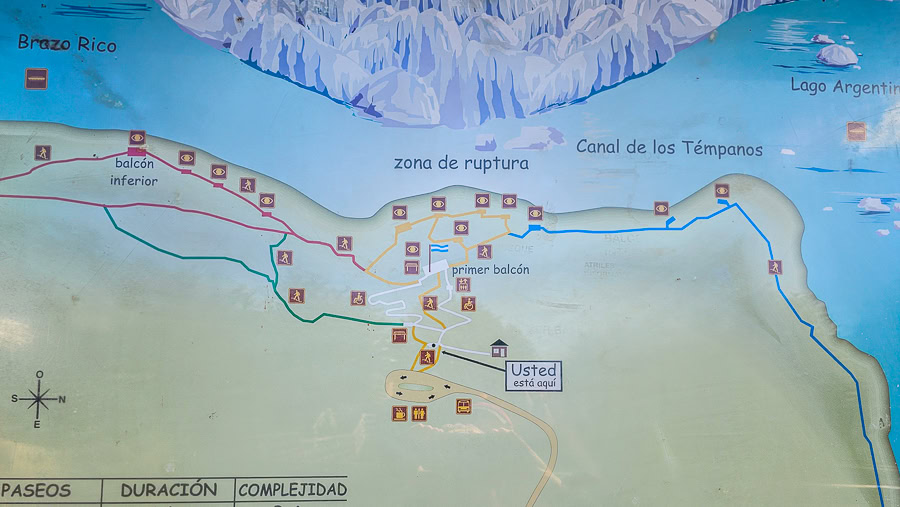
We arrived at 11:20 AM and had until 1:15 PM — nearly two hours. The Perito Moreno Observation Area is on the Magallanes Peninsula, directly across a channel from the glacier. Four color-coded wooden walkways let you view the glacier from different heights and angles.
Lucia gave us practical advice. The yellow route (center) should be your first priority, followed by the blue (right side). Skip the red — it goes left, which is where the boat tour would take us later anyway. Skip the green too; it goes through a forest. Each level brings you closer to the glacier and more at eye level with it. The lower you go, the better. Two hours is enough time for the yellow and blue routes — as long as you’re not an idiot like me.
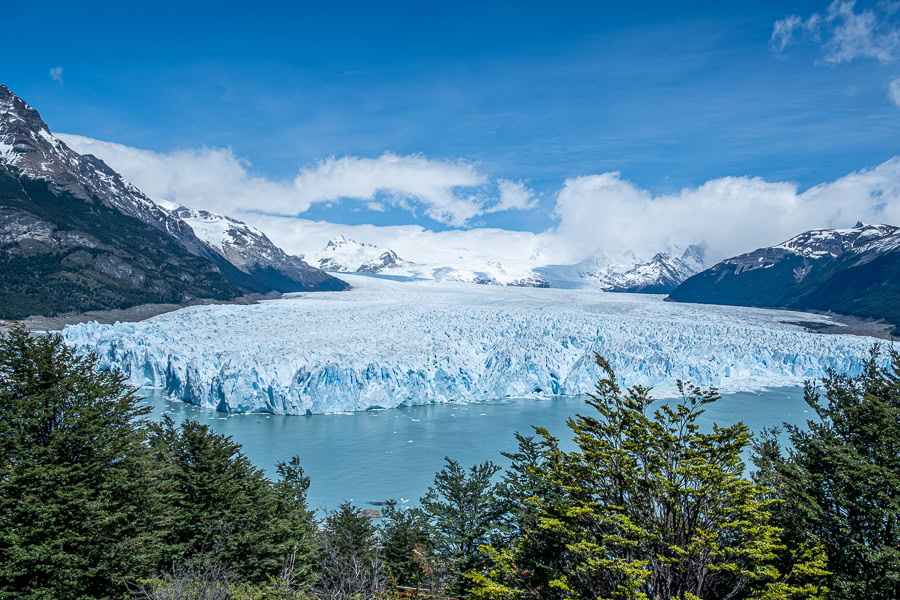
This was my first complete view of a glacier. Ever. And it hit me harder than I was expecting. The photos don’t prepare you for the scale of it — that wall of ice stretches on and on, and the blue is something else entirely. The views only got better the lower I made my way down the walkways. I didn’t expect to be that close to the glacier from the observation deck alone.
At one point, a section of the glacier broke off and fell into the lake with a sound like a cannon going off. That’s calving. It’s a natural process — nothing to do with climate change. Perito Moreno is one of the roughly 10% of glaciers in the world that hasn’t retreated. It advances about 2 meters a day, and bits fall off during calving, balancing it out.
Every few years, though, the glacier advances far enough that it touches the Peninsula, forming a dam that completely blocks the channel. This causes Brazo Rico (the body of water on the left side, which our tour would be sailing across soon) to rise. The last time it did this was in 2019. It raised Brazo Rico 30 meters until the pressure built up so much that the ice dam ruptured and collapsed. You can see the dramatic video of it at the Glaciarium Museum in El Calafate.
If you want the best chance of seeing calving, the sweet spot is 2:00 PM to 6:00 PM, when temperatures rise, and the glacier moves more.
There’s a cafeteria on site. I skipped it. The line was LONG, and there’s no good reason to spend your glacier time queuing for mediocre food. I packed a tuna sandwich and ate it on a bench with the glacier in front of me. That is the correct decision.
There are also plenty of restrooms — even for women — in the basement of the cafeteria. Despite the crowds, I never had to wait in line.
One honest confession: I wasted time. I misjudged where I was on the map, turned back too early, and missed the blue route entirely. I also factored in too much time to get back to the parking lot — it takes 15 minutes, tops. Don’t make my mistake. Budget your time carefully and do both routes.
Boat Ride to the shore opposite the Bajo de las Sombras port.
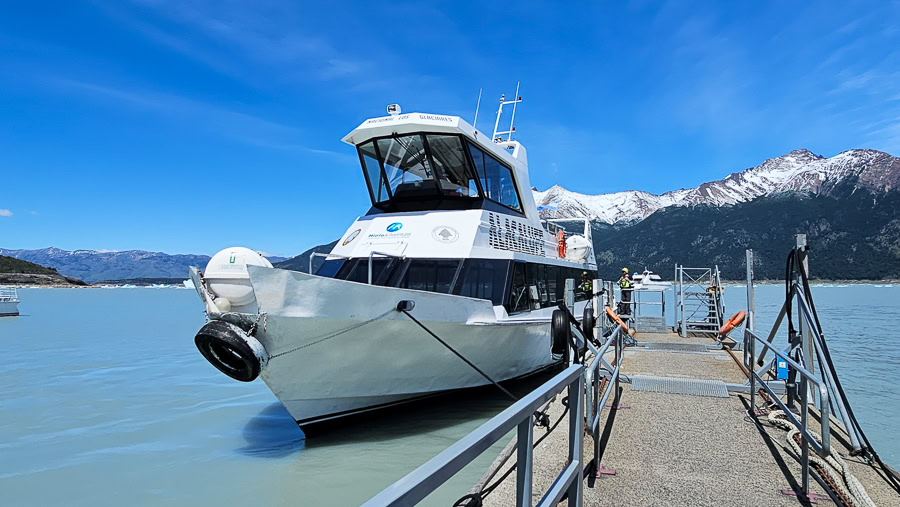
We got to the Bajo de las Sombras port at 1:40 PM and boarded a boat at 1:50. The crossing to the opposite shore took about 20 minutes across Lago Rico.
On the way over, save your camera energy. You’ll get much better views and better angles on the return trip, when the captain takes his time and gets closer to the glacier. I wish someone had told me that.
The Hike to the Glacier
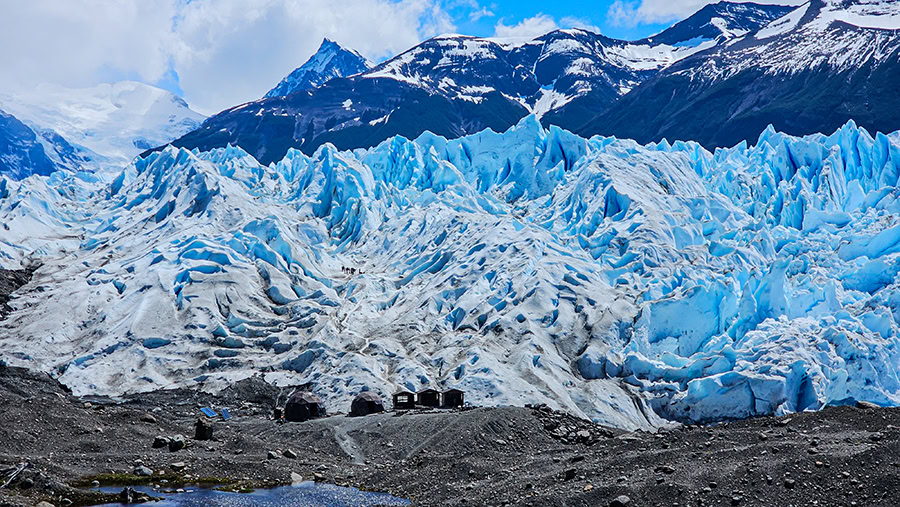
We landed on a rocky shore at 2:10 PM. No facilities. No buildings except for some small huts in the distance (those were for the people trekking on the glacier). Just rocks, trees, hills, and the glacier off to our right.
We split into English and Spanish groups — about 8 people in mine. Lucia handed us off to a new guide.
The hike was harder than I expected. Not difficult, exactly — somewhere between easy and medium. Up and down small hills, over rocky terrain. About 1.5 km (1 mile) total, and the whole round-trip experience took around 90 minutes. Long and hard enough of a hike to make me feel like I earned the view. And I didn’t need to sell a kidney to pay for the crampons!
And THIS. This is where the Blue Safari earns every dollar.
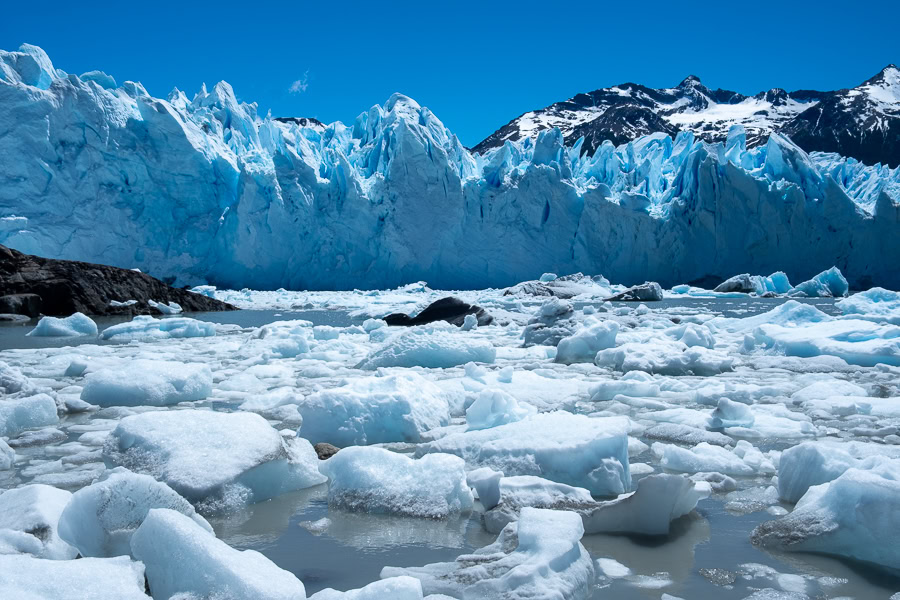
The closer we got to the glacier, the more impressive it became. If I was in awe at the walkways, here I was a hundred times more awestruck. From the observation deck, you’re looking down on the glacier. From the shore, you’re looking up at it. Twenty stories of ice above your head. The scale only hits you when you’re standing next to it at ground level.
And that blue. It was impressive from the walkways. But now, seeing it up close, it looked almost alien. A blue like that shouldn’t exist in nature.
There’s a scientific explanation. Ancient compressed glacier ice absorbs all the other wavelengths in the light spectrum — red, yellow, green — except blue. So those older layers appear blue to our eyes. Compare that with the top layers of the glacier, which are just newer, uncompressed snow. That snow reflects all wavelengths of light, which is why it looks white.
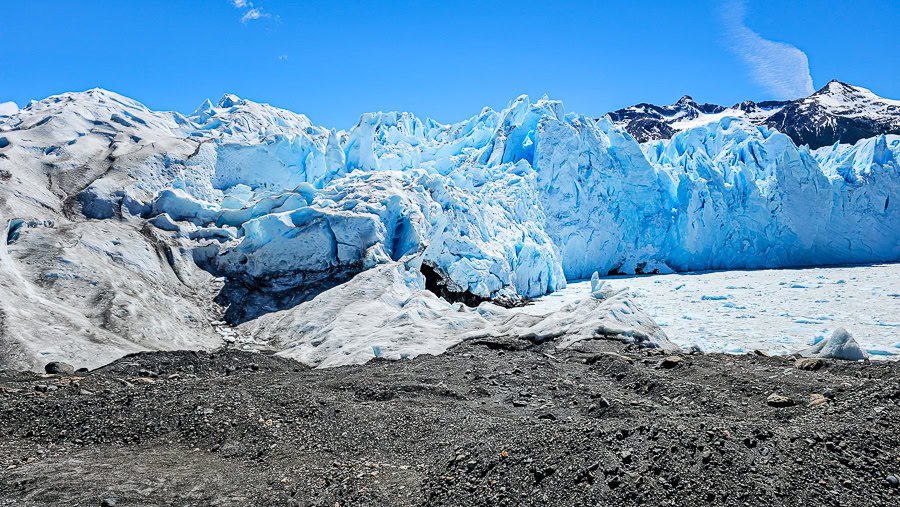
We got close enough to the glacier wall to touch it. Cold and wet. Like hard compacted snow. Whiter on top and bluer on the bottom. But up close, you can also see the dirt and grime covering the top layer of snow and ice. For a moment… the glacier lost a tiny bit of its beauty. Still worth it.
During the whole experience, we were not jostling with 100 other people for the best views. It was just our small group of eight people and a guide.
At 3:15, we made our way back via a different route — along a wooden walkway through a forest of Nothofagus trees (native to Patagonia and Australia, and nowhere else in the world). More views of the glacier, this time framed by the green of the forest.
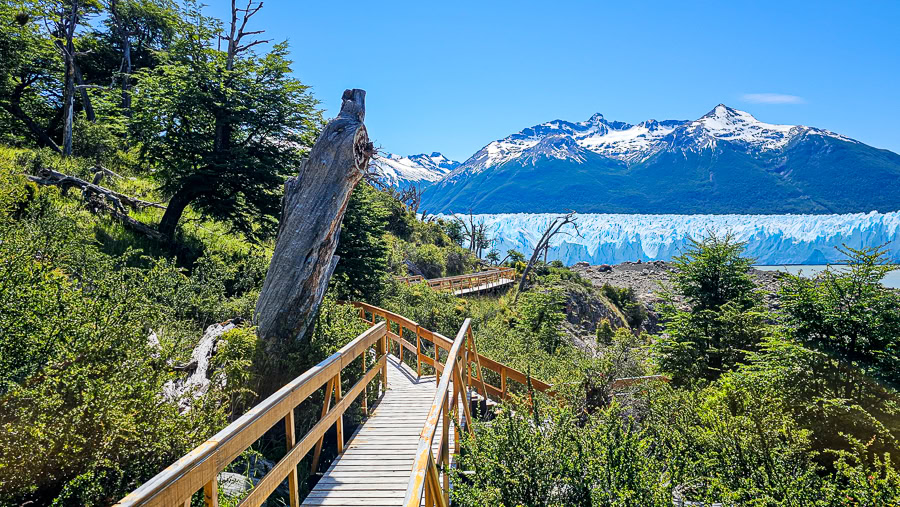
There are no toilets on the hike. If you need one, the only practical spot is right before you take the wooden walkway through the forest.
When we got back to shore at 3:43, a hot cup of coffee was waiting for us. Much appreciated.
We were then hustled back onto the boat at 4:00 PM. Apparently, glacier movement can shift the boat’s position at the dock. I didn’t fully understand the logistics. But when the guide says move, you move.
Boat Ride Back to Port
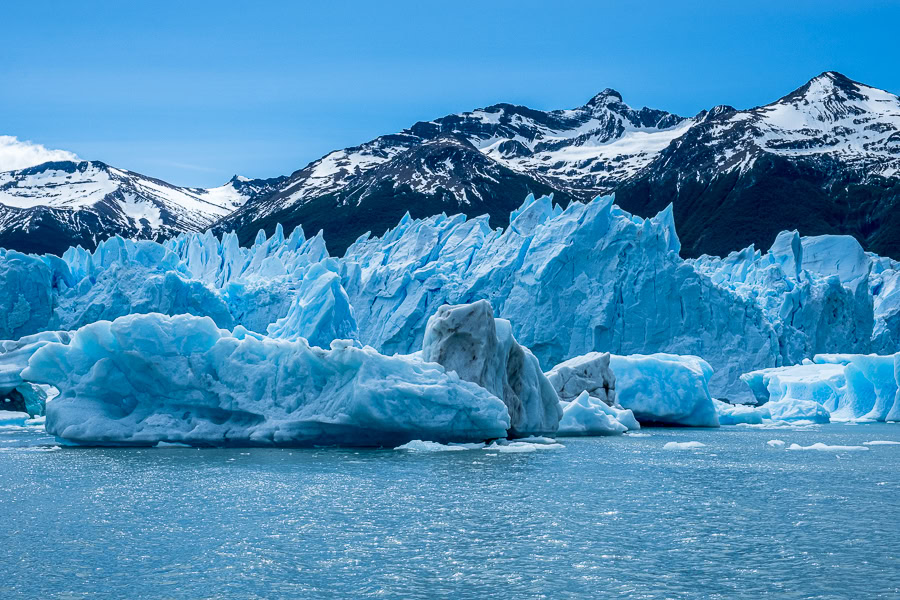
This is where the boat ride earns its place on the tour. The captain took 30 minutes getting back — slowly, close to the glacier face, past icebergs. Plenty of time for photos.
They served Calafate berry liquor with ice chipped from the glacier. It tasted like cough syrup. Patagonia, you do many things beautifully. This isn’t one of them. Argentina should look across the border and adopt Chile’s Calafate Sour.
I was back at my hotel by 6:04 PM.
What to Bring On The Tour
The glacier creates its own microclimate. Even on a warm, sunny day — which is rare in Patagonia — it can get cold and windy on the walkways and at the water’s edge. Come prepared.
- Water
- Lunch — Pack it. Don’t rely on the cafeteria.
- Hiking shoes — the shore hike is rocky and uneven
- Sunglasses – the glare of the glacier is not good for your eyes
- Layers — you’ll add and remove them all day
- Gloves
- Wool cap
- Jacket — waterproof is recommended; mine wasn’t, but I got lucky with the weather
- Sunscreen
There are two small convenience stores selling snacks and drinks at the Walkway.
My Verdict: The Best Tour for Travelers Who Can’t (or Don’t Want to) Trek
If you can do the mini-trek or Big Ice trek, go for it. Strapping on crampons and walking across a glacier is a once-in-a-lifetime experience, and no other tour matches it.
But if you’re over 65. Or over a BMI of 30. Or have a pacemaker. Or just don’t want to drop $300+ on a single tour — you are NOT stuck with distant views from the walkways.
The Blue Safari gave me three completely different ways to experience Perito Moreno in a single day: from above on the walkways, from the water on the boat, and from the ground at its base. I got to stand at the foot of a 20-story wall of ice and touch it with my hand. That’s something 95% of Perito Moreno visitors never do.
And for the same price as a tour that only gives you two of those three experiences.
If you’re going to Perito Moreno and the trek isn’t an option for you, this is the tour. Book the Safari Azul. Stand at the foot of that glacier and look up.
Travel Resources for South America
Argentina
Colombia
- Medellin Tours Worth Your Time and Money
- Medellin Itinerary: 4-6 Days in the City of Eternal Spring
- Bogota Tours That Are Worth Your Time and Money
- The 22 Best Places to Visit in Colombia
- The Best (And Worst) Books on Colombia: Read Before You Go!
Ecuador
- Ecuador Destinations To Add To Your Bucket List
- Ecuador Cuisine: Top 40 Dishes That You’ve Gotta Try
- Ecuador Reading Challenge: 25 Books You’ve Gotta Read
- Quito Day Trips That Are Worth Your Time and Money
- Quito Itinerary for Culture, Food & History Lovers
- Quito Bucket List Experiences: 44 Things That You’ve Gotta Do!
- Quito Tours That Are Worth Your Time and Money
- Quito Street Food Tour That You’ll Love
- Papallacta Travel Guide: How to Get There and Where to Stay
- Galapagos Packing List
- Galapagos Itinerary and Cruise Review: Galapagos Western Islands
- Galapagos Itinerary and Cruise Review: Galapagos Eastern Islands
Peru
Are you on Pinterest?
Hey! How about saving one of these pins to Pinterest to read for later?
And feel free to follow me on Pinterest, where you’ll find lots of travel articles for everywhere around the world.



0 Comments