
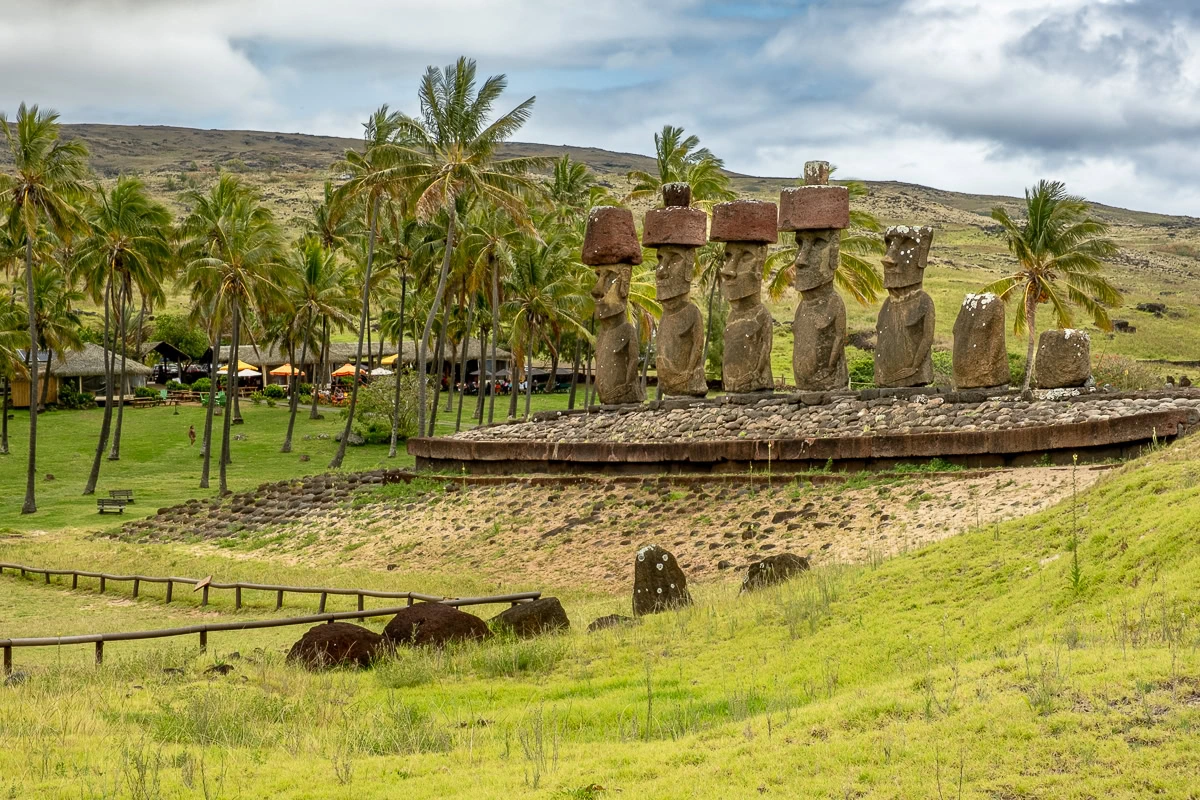
“Easter Island has the dubious distinction of being one of the most misinterpreted and misunderstood areas of its size in the world.” – Patrick McCoy (1976), quoted in The Statues That Walked.
I visited Easter Island in October 2025. It was one stop on a long trip around South America, and Rapa Nui was near the top of my must-see list. But I didn’t start planning until I was in Mendoza, Argentina, about to cross the border into Chile. Only then did I start digging into the statues that had fascinated me for years.
A week of cramming gets you a shallow understanding of a place. I managed one book and two documentaries. None of them covered what I really should have known before I stepped foot on the island.
Still, I fell in love with it. Rapa Nui was better than I expected. And I left more intrigued than when I arrived.
So after my trip, I picked up more books on the island. With every one, I wanted to kick myself. I kept learning things about its history that would have completely changed my visit, like what really happened to the Rapanui.
Hint: it wasn’t what I’d been told by either the documentaries or my guide.
Here are the best books to read before, during, or after your trip to Rapa Nui, or if you’ve never been and just want to read about one of the most mysterious (and, as McCoy put it misunderstood) places on Earth. There are six nonfiction books and two novels.
Disclosure: This post may contain affiliate links. As an Amazon Associate and a Bookshop.org Associate, I earn from qualifying purchases. Please see this website’s Disclosure for more info.
What’s It Called: Easter Island or Rapa Nui?
Dutch explorer Jacob Roggeveen landed on Easter Sunday, April 5, 1722, and named the island Paasch-Eyland (Easter Island). A Spanish expedition in 1770 renamed it Isla de San Carlos, but that name didn’t stick. After Chile annexed the island in 1888, it officially became Isla de Pascua.
Locals call it Rapa Nui. You probably will too after your visit.
But Rapa Nui isn’t the original name either. Tahitians who visited in the 1860s thought it looked like Rapa, an island in French Polynesia. So that island became Rapa Iti (Little Rapa), and this one Rapa Nui (Big Rapa). The name stuck.
Its real, real name? Some say it was Te Pito o te Henua, “the navel of the world.” The truth is nobody knows. When Europeans arrived in the 1700s and asked what the island was called, they got several answers. But none of them stuck.
Nonfiction Books on Easter Island
I read one of these before my trip. I wish I’d read all three.
The first is a practical guide that tells you what you’re looking at, site by site. The other two tell you what really happened to the people who built the statues. Together, they would have changed my whole experience on the island.
1. A Companion to Easter Island
By James Grant-Peterkin (2026)
My Rating: ★★★★★
“Only in 1966 were the islanders finally given basic human rights such as citizenship, healthcare, public education, and permission to leave the island.”


This was the only book I read before my trip. It was also my go-to once I was on the ground.
It’s a straightforward travel guide: suggested itineraries and practical tips like entry requirements, a packing list, and park ticket essentials.
But the real reason to buy it is the site-by-site coverage. Every site on the island gets its own background and practical tips. I haven’t found another book that does this.
Honest caveat: I used the 2014 edition, which has a few errors and outdated theories, such as when the Rapanui first settled the island. Some of the advice I’d skip, too. It suggests attending a church service to hear authentic Rapanui singing. I wouldn’t. My Easter Island itinerary explains why.
The new 2026 edition looks like a real revision. In the sample I read, it already includes things that match what I saw on the island. I haven’t read the whole thing, but it’s the one to buy.
My Verdict: Buy it. But pair it with one of the deeper history books on this list for the latest archaeological research.
2. Island at the Edge of the World
By Mike Pitts (2026)
My Rating: ★★★★★
“A crime against humanity led to a conspiracy of misinformation that belittled a people and one of the world’s ancient cultural wonders.”

This is the book I wish I’d read before my trip. Fascinating. Heartbreaking. Eye-opening.
Knowing the real story of what happened to the Rapanui would have made my time on the island more meaningful.
It’s also the most up-to-date book on Rapa Nui I’ve found. That matters on an island where evidence keeps rewriting the story.
The book has three parts:
- Part 1: Pitts goes straight to the question everyone asks when they first see the moai: what happened to this civilization? He takes apart the ecocide theory. His answer surprised me. It also convinced me.
- Part 2: The tragic story of Katherine Routledge, one of the most important archaeologists to study Rapa Nui, and her husband. It inspired me to read her own account of her 17 months on the island.
- Part 3: The latest research on the other big mysteries. Where did the Rapanui come from? Why did they build the statues? How did they move them?
Honest caveat: Pitts packs a LOT into 285 pages. The writing is not always very clear. I reread sentences, even whole pages, and sometimes just gave up. Take this one: “On an earlier voyage in 1999, sailing from Hawai’i via the Tuamotus, it reached Pitcairn and then Rapa Nui, seventeen days after leaving Mangareva.” Better editing would have helped.
My Verdict: Buy it along with A Companion to Easter Island, and read it before your trip. Want something shorter and easier? See the next book.
3. The Statues That Walked
By Terry Hunt and Carl Lipo (2011)
My Rating: ★★★★★
“History is the witness that Rapa Nui suffered near genocide, not self-inflicted ‘ecocide.'”

Another book I wish I’d read before my trip.
Archaeologists Hunt and Lipo are best known for their theory (and videos) on how the Islanders “walked” the Moai. They covered that plus the island’s other big mysteries. What happened to the trees? Why did the Rapa Nui build the statues? And what really happened to the civilization?
Their answer to that last question matches Pitts’s: disease, slavery, and stolen land. They reject ecocide even more forcefully.
Honest caveat: the book came out in 2011. Pitts’s newer research rejects some of their theories, including the walking moai and the idea that raps wiped out the palm forests.
Still, I enjoyed this one more. It’s simply better written. Even at its most technical, the prose is so clear that I sailed through it. I also preferred their tone. Pitts is bold and frank, and he isn’t afraid to call people out. He labels Heyerdahl’s ideas “explicit racism.” Some readers will like that. I found it less effective. Hunt and Lipo credit Heyerdahl’s contributions, lay out his errors, and let you draw your own conclusions.
It’s also short: about 180 pages to Pitts’s 285, not counting notes. Honestly, I wish it were longer.
My verdict: Which one would you read? Both, if you can. There isn’t much overlap. If you only pick one, go with Pitts. His research is more up-to-date.
For Readers Who Really Want to Nerd Out
Start with Pitts or Hunt and Lipo. They give you the big picture and the latest research.
These next three are for when you want more. They’re the sources the other books are built on: firsthand accounts from the first visitors, plus fieldwork from the early 1900s. They’re harder to read, and two of them are harder to find, but you get the original words, and you get to decide for yourself what they mean.
4. The Mystery of Easter Island
By Katherine Routledge (1919)
My Rating: ★★★★★
“Such is Easter Island. It bears no resemblance to the ideal lotus-eating lands of the Pacific; rather, with its bleak grassgrown surface, its wild rocks and restless ocean, it recalls some of the Scilly Isles or the coast of Cornwall. It is not a beautiful country nor even a striking one, but it has a fascination of its own.”

Pitts’s chapter on Katherine Routledge sent me straight to this book.
Nearly every book on Rapa Nui mentions her. She and her husband are among the most important archaeologists ever to study the island.
This is Katherine’s account of their expedition, including nearly 17 months on the island in 1914-1915, surveying ruins and interviewing locals. Some of the elders she spoke with remembered life before the slave raids of 1862 and the missionaries and ranchers who followed. They told her about the Birdman competition, the legends, and the writing system.
You’ll meet the same topics in the other books on this list: cannibalism, the statues, the legends. But here you’ll get the original source, so you can draw your own conclusions instead of reading someone else’s interpretation.
Honest caveat: it’s a slog at times. Katherine writes in an old-fashioned style. She loves the passive voice, and she loves turning every sentence into a paragraph.
She was also a woman of her time. Some of what she writes can sound racist and classist to modern ears.
Still, a firsthand account from one of the island’s most important researchers is worth the patience.
My verdict: Read it after Pitts’s book or Hunt and Lipos so you have the context to read her critically.
5. Easter Island: Island of Enigmas
By John Dos Passos (1971)
My Rating: ★★★★☆
“There exists in the midst of the great ocean, in a region where nobody goes, a mysterious and isolated island; no other land is near it and for more than eight hundred leagues in all directions empty and terrifying immensities surround it.” – Pierre Loti, quoted in the book

After Routledge. I wanted more firsthand accounts. I didn’t expect to find any. Then I stumbled on this book.
It collects the accounts of the first outsiders to visit Rapa Nui: Jacob Roggeveen (1722), the Spanish expedition sent by the Viceroy of Peru (1770), Captain James Cook (1774), Jean-François de la Pérouse (1786), French writer Pierre Loti (1872), and American William J Thomson (1886).
Reading their own words, not someone else’s paraphrase, I notice things the other books never mentioned.
One was how the visitors’ names for the Rapa Nui changed over time. First they were “Indians.” Then “savages.” Finally, just “islanders”, but in a patronizing way.
The other was Thompson. He arrived about 20 years after slave raids. Disease, kidnapping, and emigration had cut the population to as low as 111. Over 11 days, he repeatedly described corpses lying in the open in various stages of decay. None of the other visitors wrote anything like it.
The book also reprints a watercolor by a member of Cook’s crew, showing statues lining the coast. It’s the only image I’ve seen of what those first visitors saw.
Dos Passos’s own 1969 tour is the dullest part. Luckily, it’s short.
My verdict: Only if you’ve read Pitts or Hunt and Lipo and want to dig deeper. I enjoyed it, but it’s the last book on this list I’d pick up. It’s short and the price is steep for what you get.
6. Ethnology of Easter Island
By Alfred Métraux (1940)
My Ratings: ★★★★★
“There is no other Polynesian island where the past is so little known as that of Easter Island.”

Another lucky find. A priceless one.
Unlike Dos Passos slim book, this is a 455-page tome covering just about everything you’d want to know about Rapa Nui customs and beliefs.
Alfred Métraux, a Swiss-Argentine anthropologist, visited Easter Island from July 1934 to January 1935. Gathering information wasn’t easy. Only two living Islanders remembered life before the missionaries and slavers of the 1860s, and their memories were patchy. He relied mostly on Juan Tempano, the same interpreter Katherine Routledge used.
The book combines his own research with nearly everything written about the island before him. Hairstyles, clothing, fishing, food, plants, boats, tattooing, social classes, taboos, gods, houses, legends. It’s all here. At time, it’s overwhelming.
But it’s full of gems. A few favorites:
- The signatures in Rapa Nui script on the 1770 document signing the island over to Spain.
- Sketches of tools, weapons, and wooden statues held in museums around the world.
- Every recorded folktale in Rapa Nui and English side by side.
- His charts, my favorite, compare 4 lists of past kings collected by 4 different researchers in parallel columns.
Luckily, his writing is clear and concise, so it’s an easy read.
My only criticism: I wish he had done more analysis.
My verdict: It’s a gem. If you read just one more book after Pitts or Hunt and Lipo, make it this one. It’s out of print, so finding a copy won’t be easy. If you see one, grab it (as long as the price is not too high). I read the book through Open Library.
Fiction Set on Easter Island
I love reading novels set in places I’ve visited. A good one prepares you for a trip or lets you relive one afterward. You get the landscape, the people, the weather.
Novels set on Rapa Nui are rare. I’ve only found two. One I can’t recommend. The other I haven’t been able to get my hands on, but I love the series it’s from. Not a great track record. But here’s what I can tell you.
7. Easter Island
By Jennifer Vanderbes (2003)
My Rating: ★★½☆☆
“Easter Island was like every other landmass in the world—when after centuries of isolation it met the rest of the world, the world struck it down. But what could be done? Wasn’t all prehistory and history—speciation, human migration, exploration—just an elaborate game of musical chairs”

I’m lukewarm on this one. Some characters intrigued me. Others bored me.
The novel weaves together 3 storylines.
The first, set in 1914 and inspired by Catherine Routledge, follows Elsa, her sister Alice, and Elsa’s archaeologist husband Edward to the island. The pace is painfully slow. The author wants us to feel for Elsa. I just wanted to go to sleep. The twist at the end comes with so few clues that it just feels odd.
What kept me reading was the second story. In 1973, palynologist Greer arrives to study the island’s lost plants. Little happens on the island. Her backstory is the real draw: academic cheating, jealousy, and a narcissistic husband. I also nerded out on the botany, from the search for the first flower to the trees that once covered Rapa Nui.
The third storyline follows German Vice Admiral von Spee’s World War I fleet to the island (It really happened. Von Spee’s squadron stopped at Rapa Nui in 1914 while the Routledge’s were there). It still could have been cut.
My biggest disappointment. The book never took me to Easter Island. The constant wind, the rocks everywhere, everything a visitor notices first, is missing. I began to wonder if the author had ever been there.
My verdict: Skip.
8. The Moai Murders
By Lyn Hamilton (2006)
My Rating: Haven’t read it yet

I love Lyn Hamilton’s archaeology mysteries. I’ve read the first three in her series of 11. Sadly, I haven’t been able to read this one. It’s out of print, and I can’t find a digital copy. Hamilton has also since passed away.
Each book stars Laura McClintock, a Canadian antiques dealer and amateur sleuth, and each mystery centers on an archaeological discovery in a different country. In this one, Lara and her friend Moira are vacationing on Easter Island when an archaeologist is murdered.
I love Lara, the mysteries are fun but believable, and there’s plenty of nerdy archaeology. I’d be surprised if this one were any different.
My Verdict: If you can track down a copy, it looks like a fun read for the plane. I’m still looking for mine.
Final Thoughts
I left Rapa Nui fascinated. After all these books, I’m more fascinated than ever. I also have more questions than ever.
Most of all, I’d love to hear what the Rapa Nui themselves think. If I had read these books before my trip, I would have known what to ask. My guide was Rapa Nui, and I wish I had asked him questions like these.
- Why were there so few women? Skeletal remains and early visitors’ accounts suggest about 100 men for every 75 women.
- What clan did your ancestors belong to? Where on the island did they live?
- What do you think the Rongorongo writing system says?
- What are the biggest problems facing the island today?
I want to experience the island again. Knowing all that I know now. This time I’ll come prepared.
Don’t make my mistake. Read as much as you can before you go and bring a list of questions for your guide. Otherwise, you might miss things the way I did.
- The roads the Rapa Nui built to move the Moai from the quarry to every part of the island.
- Puna Pau, the quarry where they carved the red topknots.
- The petroglyphs at Orongo. I now know the googly-eyed ones represent their God, Maka Maka.
I didn’t know to look for them.
Read first. Then go.
Are you on Pinterest?
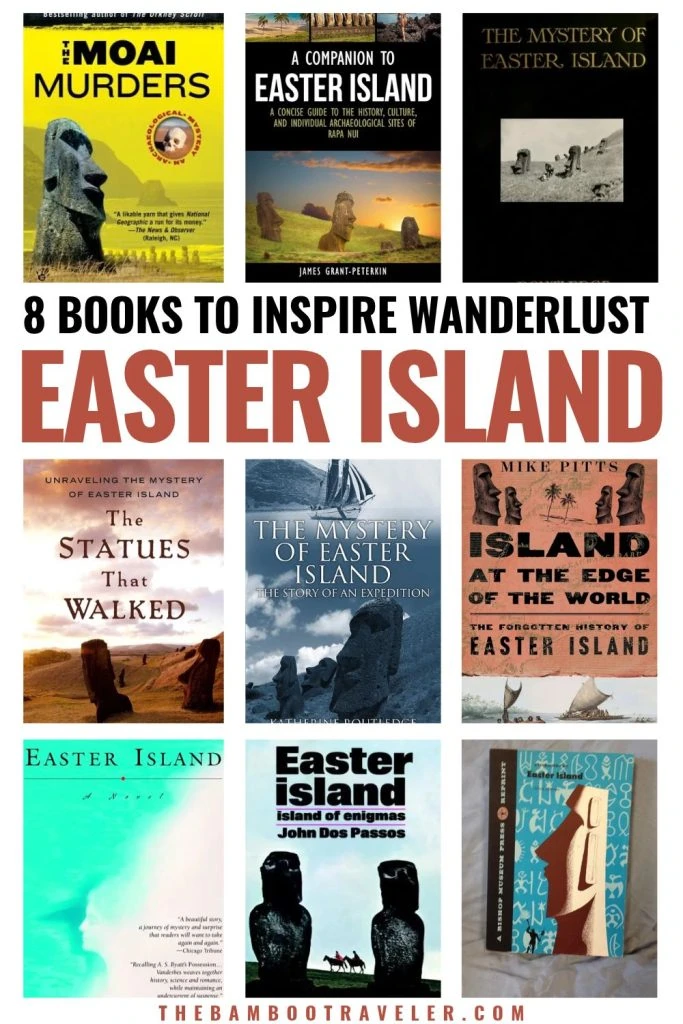
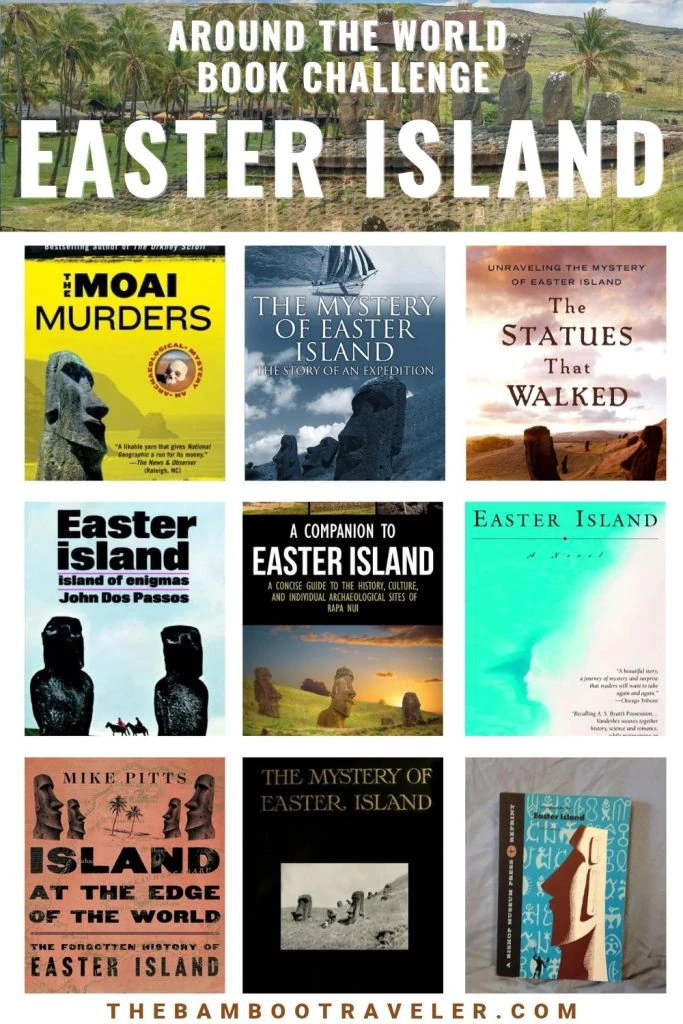
Hey! How about saving one of these pins to Pinterest to read for later?
And feel free to follow me on Pinterest, where you’ll find lots of travel articles for everywhere around the world.
Books From Around the World
- Books on Cambodia
- Books on China
- Books on Colombia
- Books on Ecuador
- Books on Guatemala
- Books on Hong Kong
- Books on Indonesia
- Books on Japan
- Books on Korea
- Books on Malaysia
- Books on Myanmar
- Books on Panama
- Books on Russia
- Books on Singapore
- Books on Sri Lanka
- Books on Thailand
- Books on Ukraine
- Books on Vietnam



0 Comments