
I am an idiot.
Five years of nomadic travel. And I still leave my phone on desks in bus stations. I still overpay. I still don’t read my travel insurance policy closely enough.
This is the story of how that last one cost me 47,620 hard-earned airline points.
But it’s also the story of how SafetyWing quietly came through when I needed it most — and why, after five years as a customer, I’m still with them.
If you’re here because you’re wondering whether SafetyWing is actually worth buying, you’re in the right place. I’m going to tell you what it covers, what it doesn’t, how their claim process really works, and how fast they pay. Real numbers. Real dates. No vague “it was great!” An honest and unbiased review.
Let’s start with the mistake.
My SafetyWing Story
I’ve been on SafetyWing’s Nomad Insurance Essential plan continuously since April 2021. I also used it briefly in early 2020, right before the pandemic shut everything down.
I’m in my 50s. That means I pay $155 a month — not cheap, but nowhere near what traditional health insurance costs. For context, if you’re in your 20s or 30s, you’re paying around $55 a month. These are 2026 prices. Heads up: SafetyWing raises their rates every year, and the increases have been significant.
Anyway. Back to my idiocy.
My Mother Died While I Was in Argentina

I flew back to Minnesota. Last-minute ticket. You know what last-minute flights cost.
The ticket was $764.83.
Three months earlier, I’d also flown back from Chile — also last-minute — when doctors told us my mother was dying. She didn’t die that time. But I went anyway.
So when she actually passed, I did what any exhausted, grieving, and almost broke traveler does: I tried to save money. I used all of my 47,620 credit card rewards points to cover most of the ticket. I paid $210.61 out of pocket. I burned every point I had.
And then…
I went onto SafetyWing’s website to check something unrelated — how many days of U.S. coverage I had left. (I thought it was 15 days per year. It’s actually 15 days for every 90-day period. Much better than I realized.)
And something on the page caught my eye.
Trip Disruption.
Hmm.
I dug in.
SafetyWing covers up to $5,000 for trip disruption — specifically for emergency travel back to your home country when a family member dies.
I had just done exactly that.
And I had just burned 47,620 points to pay for a ticket I could have gotten fully reimbursed for.
Idiot.
Idiot.
Idiot.
Filing a Claim With SafetyWing: Step by Step
This wasn’t my first claim. Back in 2024, I filed a medical claim for a foot injury I got in Mexico — got my foot crushed right outside of Puerto Vallarta. The claim was approved. But because SafetyWing had a $500 annual deductible at the time, and my claim was under that, I never saw a cent. It also took months to process.
That old system was frustrating. A confusing PDF form. Upload it. Then wait. For months.
In 2024, SafetyWing overhauled its system. The deductible is now ZERO. The claims process moved entirely online. And because so many people complained about the wait times, they sped things up.
They also raised their prices significantly — my plan went from $115/month to $155/month, and it’s now advertised as $171/month. That’s the trade-off.
This trip disruption claim would be my first time using the new system.
What Documents Do You Need?
Here’s where I want to save you the headache I had.
SafetyWing’s website listed two required documents:
- Death certificate
- Flight receipt
That’s not the full list.
After I started my claim, I discovered I also needed:
- My birth certificate (to prove my relationship to the deceased)
- My boarding pass
I was back in Argentina. No birth certificate. No paper boarding pass — I’d just bought a new purse and tossed everything from the old one.
Fortunately, I found the boarding pass buried in my coat pocket. Lucky. The birth certificate? I used my mother’s obituary instead, which listed me by name as her daughter. I crossed my fingers hoping that SafetyWing would accept it.
Here’s my honest advice: before you get on that plane, contact SafetyWing via chat and ask them exactly what documents you’ll need. Don’t rely solely on what their website lists. Ask first, gather everything, then submit once. The good news is that after my experience, they have updated their website with an expanded list of needed documents.
The Claims Process: What It’s Actually Like
The new system is all online. You fill out forms, make selections, upload documents. No PDF. No printing.
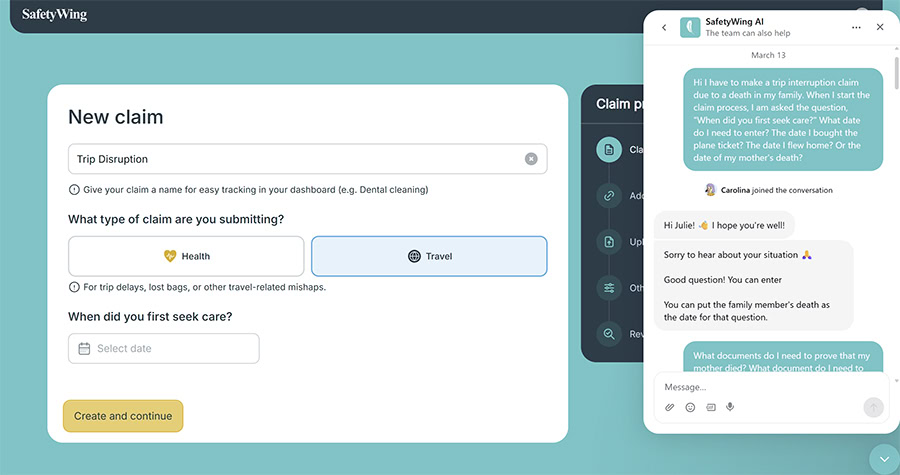
Some questions are genuinely confusing, though. Two that tripped me up:
- “When did you first seek care?” — easy for a medical claim, confusing for trip disruption. A SafetyWing rep told me: The date the family member passed away.
- “Where did the incident take place?” — Where my mother died? Where I took my flight? A SafetyWing rep told me to enter Argentina.
Not a problem. Every time I had a question, I’d go to SafetyWing’s support chat. Usually a SafetyWing agent would answer within a few minutes. Was it an AI Bot or a real person? It felt like a real person. But nowadays you never know.
The Timeline
March 19: I submitted the claim.
March 23: SafetyWing emailed asking for additional proof of purchase — a receipt and a bank statement showing I actually paid for the ticket. I submitted a credit card receipt and a redacted bank statement (I used Photoshop to delete all other line items).
March 25: Claim approved.
March 31: A follow-up email confirming approval.
April 1: Money deposited directly into my bank account.
For $764.83. The full ticket price.
Not $210.61. The full $764.83.
13 days from submission to deposit.
SafetyWing came through.
What Is SafetyWing?
SafetyWing is a global travel medical insurance company built specifically for people who live, work, and travel outside their home countries. It’s ideal for digital nomads and long-term travelers.
It was founded in 2018 by three Norwegians and is headquartered in San Francisco.
They didn’t come from the traditional insurance world. They came from the nomad world. And I think it shows in how the product is designed. They understand nomads and long-term travelers.
SafetyWing Insurance Plans
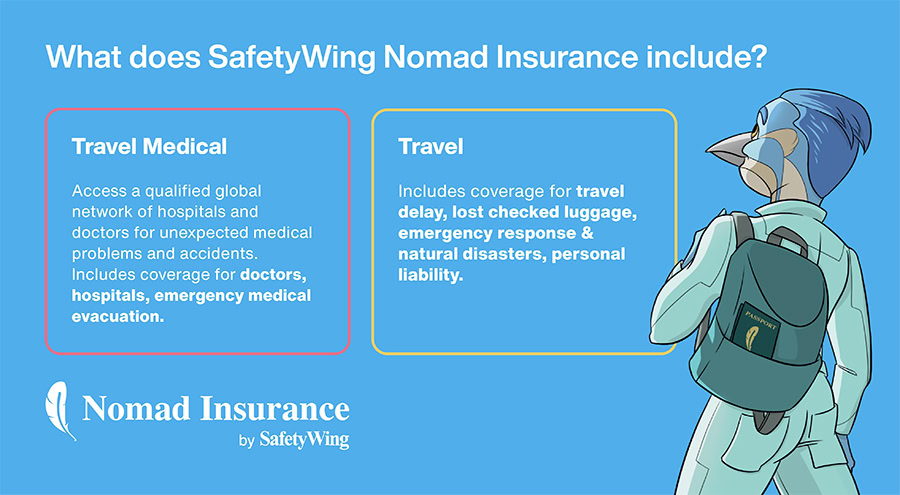
SafetyWing offers two individual plans. Here’s what you need to know about each.
Nomad Essential — Travel Medical Insurance
The Nomad Essential Plan is the one I have. It’s been their flagship since 2021 and it’s designed for emergency coverage while you travel. Think of it as a safety net, not comprehensive health insurance.
What it covers:
- Medical treatment and hospitalization (up to $250,000)
- Emergency evacuation to a better-equipped hospital
- Injuries from leisure sports and activities
- Motor vehicle accidents (if licensed, sober, and wearing safety gear)
- Emergency dental (up to $1,000)
- Trip delay or cancellation
- Lost checked luggage
- Trip disruption (up to $5,000 for emergency travel home due to a family death)
- Arrangements in the event of your death
Home country coverage: 15 days for every 90-day period of active coverage. Not per year — I had this wrong for years.
One thing worth knowing: the window depends on where you’re from. If you’re American, SafetyWing Essential covers emergency medical treatment within the first 15 days of arriving back in the US. If you’re from anywhere else, you get 30 days from your arrival date. Either way, you need proof you planned to leave again (a return ticket, for example).
Note for American readers: your home country window is 15 days, not 30. Plan accordingly.
Pre-existing conditions: not covered.
Optional add-ons:
- Extreme sports coverage (skydiving, paragliding, etc.)
- Electronics theft: up to $1,000 per item, $10/month — save your receipts if you use this
Pricing (2026):
- Ages 18–39: ~$55/month
- Ages 40–49: ~$100/month
- Ages 50–59: ~$155/month
- Ages 60–69: ~$218/month
Prices increase every year. Plan for that.
Nomad Complete — Full Health Insurance for Long-Term Nomads
The Nomad Complete plan is the one for people who live abroad full-time and want real health coverage, not just emergency coverage.
It includes everything in Essential, plus:
- Doctor and specialist visits
- Routine checkups and preventive care
- Wellness therapies: chiropractor, acupuncture, dietician
- Mental health: psychologist and psychiatrist visits
- Cancer tests and treatment
- Maternity care
- Trip cancellation
- Stolen belongings
It requires a 12-month commitment. Pre-existing conditions are not covered.
Pricing (2026):
- Ages 18–39: ~$177.50/month
- Ages 40–49: ~$253.50/month
- Ages 50–59: ~$380.50/month
- Ages 60–64: ~$681.50/month
Additional Add-ons
- Singapore, Hong Kong, and U.S. Coverage – Safety-Wing Complete does not cover these places. You can add them onto your plan for an additional cost. It’s pricey. For example, for ages 50-59, the price goes from $380.50 to $684.50 per month!
- Dental coverage
- Electronics theft – $20/month
My honest take: most routine doctor visits in Southeast Asia, Latin America, and Eastern Europe cost $20–50 out of pocket. If that’s where you spend most of your time, Essential may be enough. If you need routine care covered or you’re based somewhere with expensive healthcare, Complete is worth the upgrade.
Other Things I Like About SafetyWing Essential
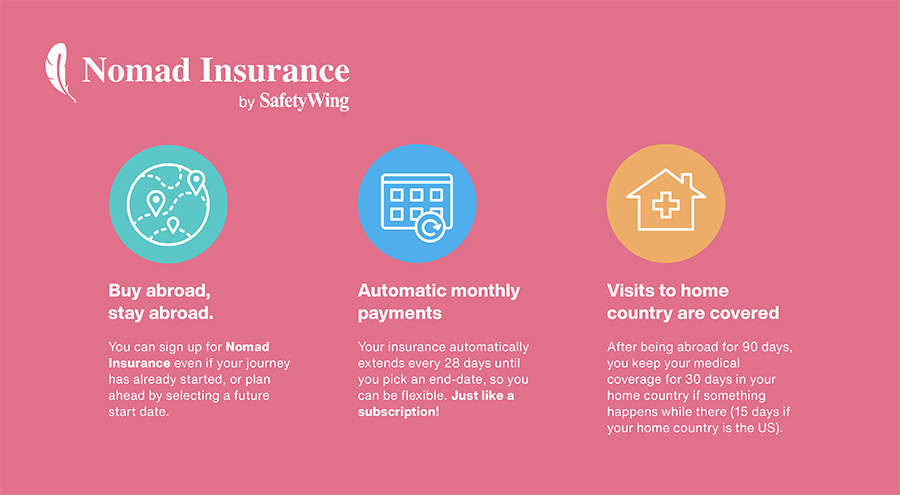
Monthly Subscription. No Annual Lock-In.
This is huge. Most international travel insurance requires you to commit to a full year upfront.
SafetyWing renews automatically every month. Cancel anytime.
When COVID hit in 2020, I had to stop traveling three months into my nomad journey. If I’d locked into annual insurance, I would have been paying for coverage I couldn’t use for nine months. Instead, I just canceled. And when I needed to cancel because I was back in the U.S., SafetyWing had just charged me for a new month. I couldn’t use it. I called them and they canceled my insurance for that month and reimbursed me.
For SafetyWing Complete, you must pay for the whole year upfront.
You Can Buy It After You’ve Already Left Home
Most insurers won’t cover you if you’re already abroad when you buy. SafetyWing will.
This matters more than you’d think. I’ve used it. I know other travelers who realized mid-trip they had no coverage and signed up from a café in Bangkok.
The Chat Feature Actually Helps
When I got my foot crushed in Mexico, I was on the bus back to Puerto Vallarta. I texted SafetyWing through their chat and they gave me a list of hospitals near the bus stop.
Was it a human or an AI? That time I’m sure it was a human because chatbots weren’t that humanlike in 2024.
Download the app. Save your login credentials somewhere accessible. When you’re injured and panicking is not the time to be resetting your password.
The Find A Doctor Feature
This is new. The app now lets you search for doctors in your destination, with reviews and English-language ability ratings. It’s thin on reviews right now, but it’s a useful start.
My Verdict
I’ve been with SafetyWing since 2021. The old claims system was painful. The new one is genuinely good — 13 days from submission to deposit, no deductible, full reimbursement.
I’m 80% satisfied with the process. My main complaint: their document checklist is incomplete. List everything upfront so people like me don’t have to chase it down mid-claim.
Will I stick with them? Yes.
Is it the right insurance for you?



0 Comments